Young Systems Are Near But Not In Resonance
Young planetary systems hover near resonance—close enough for chaos, but not locked tightly enough for protection.
Dai et al. (2024) found that planet pairs are far more likely to lie close to a first order mean motion resonance in young systems: about 70% among systems younger than 100 Myr, compared with about 15% among mature systems older than 1 Gyr. A simple fit to this decline suggests a characteristic timescale of roughly 100 Myr.
This trend broadly agrees with the "breaking the chains" model. In this picture, planet migration within the protoplanetary disk assembles resonant chains. After the disk disperses and its damping disappears, dynamical instabilities can break those chains and produce the mostly nonresonant architectures seen today. The puzzle is the timing: the observed timescale of roughly 100 Myr is much longer than the approximately 10 Myr predicted by typical versions of the model.
To investigate this discrepancy, we examined three young planetary systems: AU Mic (~20 Myr), V1298 Tau (~20 Myr), and TOI-2076 (~200 Myr). Their planet pairs lie close to mean motion resonances but are not locked in resonance. Figure 1 compares the orbital architecture of these systems and shows where their planet pairs lie relative to resonance. Every system has at least one pair outside the expected libration width, suggesting that it is near resonance but not locked in it.
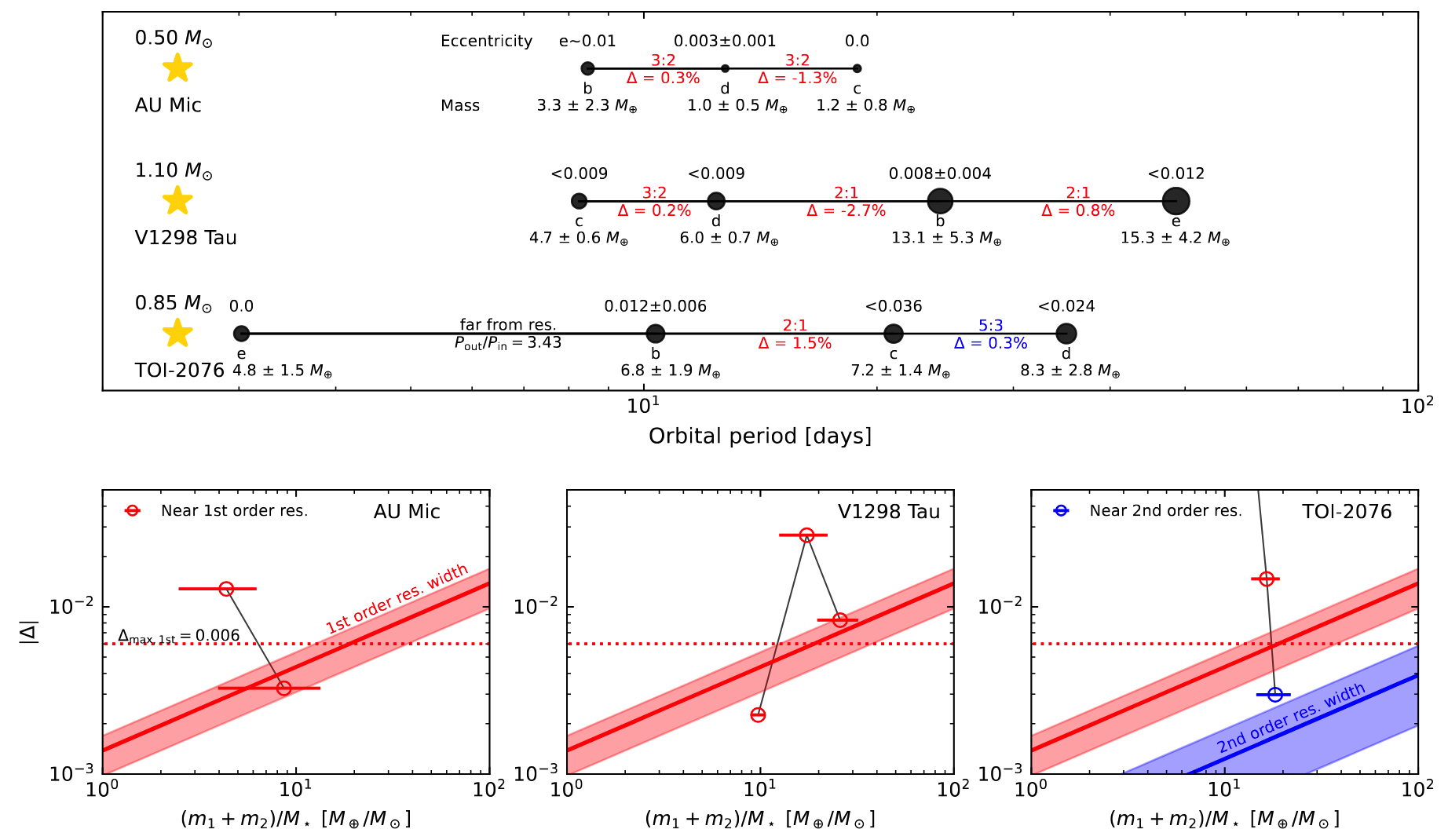
Figure 1. Upper panel: Orbital architecture of the young multiplanet systems studied here. The constraints on eccentricity and mass from TTV modeling are shown above and below each planet, respectively. The size of each planet in the upper panel is proportional to its mass. Lower panels: Pairwise deviation of the period ratio from exact commensurability (|Δ| = (P2/P1)/(p/q) -1 for p:q resonance) versus the planet to star mass ratio. Red and blue indicate first order (q = 1) and second order (q = 2) MMRs, respectively. The solid lines mark the theoretical resonance width. The shaded regions show conservative uncertainty. Each system contains at least one pair whose |Δ| falls outside the libration width, suggesting a circulating state. Full TTV analysis confirms the circulating states of these pairs, with the possible exception of the innermost pair of V1298 Tau.
Without resonant protection, even modest eccentricity excitation of a few percent can drive chaos and instability over tens to hundreds of millions of years. These results point to chain breaking in two stages. First, the chains may be gently disrupted while the systems remain stable. Later, further dynamical excitation erases the remaining near resonance structure over roughly 100 Myr. These systems may therefore offer a glimpse of the transition from young configurations near resonance to mature, nonresonant planetary systems.